

What Size Round Dining Table Do You Need? A Guide to Seating 4, 6 or More
Posted by Posted by eFurnitureHouse on 24th Sep 2026
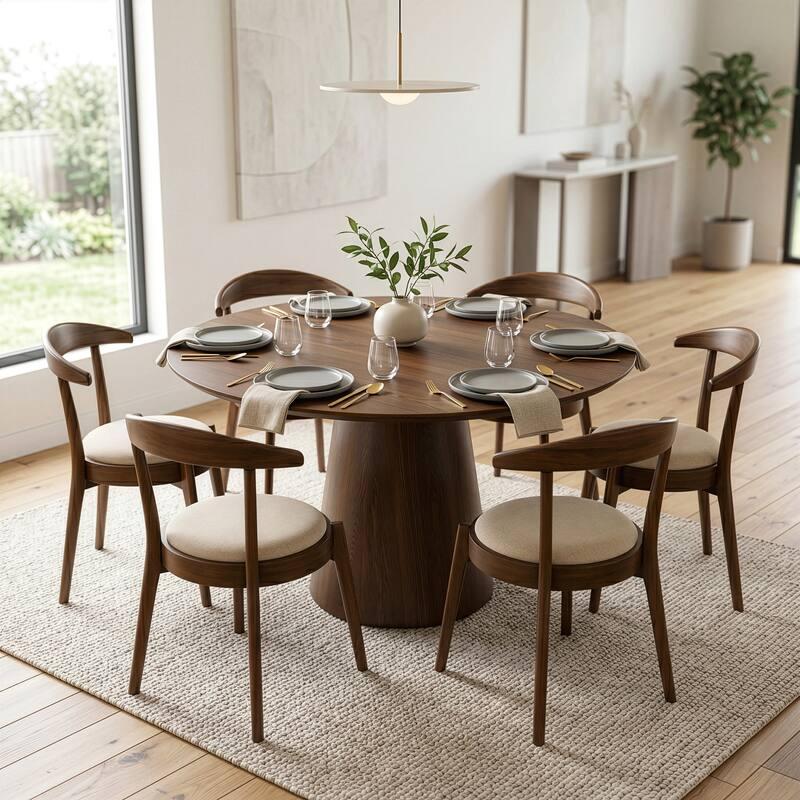
Choosing the right round dining table involves more than deciding how many chairs you want to place around it. The diameter of the table, width of the dining chairs, style of the table base and amount of space available in the room all affect how comfortably people can sit, dine and move around the table.
A round dining table can be an excellent choice for both smaller dining areas and larger gathering spaces. With no corners, round tables can make it easier to move through the room while creating a more conversational seating arrangement where everyone faces toward the center of the table. Depending on the size and design, they can comfortably accommodate anything from an intimate table for four to a larger gathering of six, eight or more.
In this guide, we'll look at common round dining table sizes, how many people they can realistically seat, how much surrounding space you should allow, and how features such as pedestal bases and extension leaves can affect seating capacity. Whether you're furnishing an everyday dining area or preparing for larger holiday gatherings, understanding these measurements can help you choose a table that fits both your room and the way you plan to use it.
How Round Dining Table Sizes and Seating Capacity Work
With a round dining table, diameter is the measurement that matters most. A table described as 48 inches round, for example, measures approximately 48 inches from one side of the tabletop to the other through its center.
As the diameter increases, so does the amount of space available around the perimeter for chairs. However, diameter alone doesn't determine exactly how many people a table can seat comfortably. Chair width, the amount of elbow room between diners and the design of the table base all play a role.
A pedestal-base table may allow chairs to be positioned more freely because there are no individual table legs competing for space underneath. A four-leg table of the same diameter may accommodate the same number of chairs, but their placement can be somewhat more restricted.
This is why seating recommendations should be treated as practical guidelines rather than exact rules. Two round dining tables with the same diameter can provide noticeably different seating experiences depending on their construction and the chairs used with them.
What Size Round Dining Table Seats 4?
For four people, a round dining table measuring approximately 42 to 48 inches in diameter is a comfortable choice for most dining spaces. This range generally provides enough tabletop space for place settings while allowing diners to sit comfortably without feeling crowded.
A 42-inch round table works particularly well when space is limited. It keeps the dining area compact while still providing practical seating for four. Chair size matters, however, especially when using wider upholstered dining chairs or chairs with arms.
A 48-inch round dining table provides additional elbow room and tabletop space, making it a versatile size for four people. The extra diameter can also make everyday dining more comfortable when serving food at the table or using larger place settings.
Smaller round tables may also accommodate four chairs, but the seating arrangement becomes tighter. When choosing among different round dining room sets, consider the size of the chairs along with the diameter of the table rather than relying on the advertised seating capacity alone.
Is a 48-Inch Round Table Big Enough for 4?
Yes. A 48-inch round dining table is generally a very comfortable size for four people. Each diner has more usable space around the table than they would typically have at a smaller 36- or 42-inch table.
A 48-inch table can be especially practical for households that regularly seat four and want enough room for serving dishes, centerpieces or additional tableware without moving up to a substantially larger table.
What Size Round Dining Table Seats 6?
For six people, a round dining table measuring approximately 54 to 60 inches in diameter is a good starting point. The right size depends on the width of the chairs, the table base and how much personal space you want each person to have.
A 54-inch round dining table can accommodate six people while maintaining a relatively compact footprint. It can be a good option when you want seating for six but don't have room for a larger table. With wider chairs, however, seating may feel somewhat tighter.
A 60-inch round dining table generally provides more comfortable seating for six. The additional diameter creates more elbow room and more usable tabletop space for serving dishes, place settings and centerpieces. For households that regularly seat six rather than only occasionally, a 60-inch table is often the more comfortable choice.
The design of the base becomes particularly important as more chairs are added. A pedestal base can make it easier to position six chairs evenly around the table because diners do not have to work around individual table legs.
Is a 60-Inch Round Table Big Enough for 6?
Yes. A 60-inch round dining table is generally a comfortable size for six people and is one of the most practical sizes for households that regularly need six seats.
It can also provide some flexibility when entertaining. Depending on chair width and the table's base design, an additional chair may sometimes be added temporarily, although seating seven around a 60-inch table will naturally be tighter than seating six.
When comparing tables, don't look at diameter alone. A 60-inch pedestal table paired with moderately sized chairs may provide a noticeably different seating experience from a 60-inch four-leg table paired with wide upholstered chairs.
What Size Round Dining Table Seats 8?
For eight people, a round dining table measuring approximately 66 to 72 inches in diameter is generally a practical choice. At this size, the table provides considerably more perimeter space for chairs while also offering enough surface area for place settings, serving dishes and shared meals.
A 66-inch round dining table can accommodate eight people, particularly when paired with moderately sized dining chairs and a pedestal base. With wider upholstered chairs or chairs with arms, however, the seating arrangement may feel tighter.
A 72-inch round dining table generally provides more comfortable seating for eight. The larger diameter gives each person additional elbow room and makes it easier to accommodate larger chairs. It also provides generous tabletop space, which can be particularly useful when entertaining or serving larger meals.
As round tables become larger, it's important to consider the distance across the tabletop as well as the seating around it. While a large round table encourages conversation by allowing everyone to face one another, reaching dishes placed in the center becomes more difficult as the diameter increases. A rotating serving tray or lazy Susan can be useful on larger round tables.
Is a 72-Inch Round Table Big Enough for 8?
Yes. A 72-inch round dining table can comfortably seat eight people in many configurations, although the size and style of the chairs still matter.
Before choosing a table this size, also make sure the room itself provides enough space. A 72-inch table has a 6-foot diameter before chairs are added, so adequate clearance around the table is essential for pulling chairs out and allowing people to move comfortably through the dining area.
Round Dining Table Size and Seating Chart
The following chart provides a practical starting point for matching round dining table diameter with seating capacity. Keep in mind that actual comfort will vary depending on chair width, table base design and how much elbow room you prefer.
Round Table Diameter Typical Seating Capacity Best Suited For
36 inches 2–4 people Small dining areas, breakfast spaces
42 inches 4 people Comfortable everyday seating for four
48 inches 4 people Roomier seating for four
54 inches 5–6 people Compact seating for up to six
60 inches 6 people Comfortable everyday seating for six
66 inches 6–8 people Larger dining areas and occasional extra seating
72 inches 8 people Comfortable seating for larger gatherings |
These measurements should be considered guidelines rather than strict rules. For example, a 60-inch round table with a pedestal base and narrower chairs may offer more seating flexibility than another 60-inch table with four legs and wider upholstered chairs.
It's also important to consider how the table will be used. A family that regularly seats six may prefer a 60-inch table for additional everyday comfort, while someone who normally seats four but occasionally hosts six may find a smaller table with an extension leaf more practical.
Most importantly, make sure the table fits the room as well as the number of people you want to seat. A dining table can technically accommodate the right number of chairs and still be too large for the surrounding space once those chairs are pulled out.
How Much Room Do You Need Around a Round Dining Table?
Choosing the right table diameter is only part of the equation. You also need enough space around the table for chairs to be pulled out and for people to move comfortably through the dining area.
As a general guideline, allow at least 36 inches of clearance between the edge of the table and a wall or other furniture. This provides enough room for most diners to pull out a chair and sit down.
If the area behind the chairs is also a walkway, 42 to 48 inches of clearance can provide more comfortable movement, particularly when people need to pass behind someone who is seated.
For example, a 60-inch round dining table with 36 inches of clearance on every side requires an area approximately 11 feet by 11 feet:
60-inch table + 36 inches of clearance on each side = 132 inches, or 11 feet
A 48-inch round table with the same clearance requires an area approximately 10 feet by 10 feet.
These measurements don't necessarily mean the entire dining room must be that size. Open floor plans, doorways and furniture placement can change how the available space functions. However, measuring from the table edge to nearby walls, cabinets, sideboards and other obstacles provides a much better picture of whether a particular table will fit comfortably.
Before purchasing, it can also help to mark the table's dimensions on the floor with painter's tape. This makes it easier to visualize the table's footprint and determine whether there will be enough room for chairs and everyday movement.
For a more detailed look at measuring your dining space, see our How to Choose the Right Dining Table Size guide.
Pedestal Base vs. Four-Leg Round Dining Tables
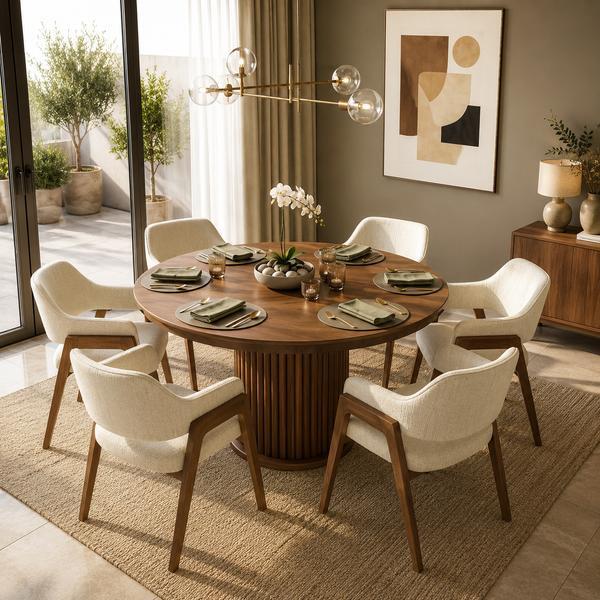
The style of the table base can make a noticeable difference in how comfortably chairs fit around a round dining table. Two tables with the same diameter may offer different seating flexibility simply because of the way their bases are designed.
A pedestal table is supported from the center rather than by individual legs positioned near the outer edge of the tabletop. This leaves more open space around the perimeter of the table and generally gives you greater flexibility when positioning dining chairs.
This can be especially helpful when trying to maximize seating. For example, fitting six chairs around a round table may be easier with a pedestal base because there are no table legs competing with diners for legroom or limiting where each chair can be placed.
A four-leg round dining table can also provide comfortable seating, but chair placement requires a little more attention. Ideally, each chair should fit between or away from the table legs so diners aren't sitting directly in front of them. Wider dining chairs can make this more noticeable.
Which Base Is Better for Maximizing Seating?
If maximizing the number of usable seats is a priority, a pedestal base generally provides greater flexibility. This doesn't necessarily mean a pedestal table will always seat more people, but it removes one of the common obstacles to arranging chairs evenly around a round tabletop.
There are other considerations as well. Pedestal bases vary considerably in size and shape, and a particularly wide base can still affect foot and legroom. With either design, it's worth looking underneath the table, not just at the tabletop dimensions, to see how much usable space diners will actually have.
For households that frequently add an extra chair for guests or regularly entertain during the holidays, this seemingly small design detail can make a meaningful difference.
Can an Extendable Round Dining Table Give You More Seating?
Yes. An extendable round dining table can be an excellent option when your everyday seating needs are different from the number of people you occasionally entertain.
For everyday use, the table can remain in its smaller round configuration, helping preserve open space around the dining area. When additional seating is needed for holidays, family gatherings or dinner guests, one or more extension leaves can increase the table's surface area and create additional seating positions.
Keep in mind that many round tables change shape when extended. Adding a center leaf may transform a round tabletop into an oval or elongated shape. This provides more seating space while maintaining the smaller footprint of a round table when the extension isn't being used.
For example, a household that normally seats four may not need a large six- or eight-person table occupying the dining room every day. An extendable table can provide comfortable everyday seating while offering additional capacity when guests arrive.
Does Adding a Table Leaf Always Mean More Seats?
Not necessarily. The amount of additional seating depends on the size of the extension, table design, base configuration and chair width.
A leaf may provide enough additional length for two more chairs, while another table may gain additional surface area without comfortably accommodating the same number of extra diners. Always check both the table's dimensions when fully extended and the manufacturer's recommended seating capacity.
Also consider the room itself. A table that fits comfortably when closed may require considerably more space when extended. Before buying, measure the dining area using the table's fully extended dimensions, including adequate clearance for chairs.
If flexibility is important, particularly when preparing for larger family meals or holiday gatherings, an extendable table can eliminate the need to choose between a compact everyday table and a permanently oversized dining table. For a closer look at extension mechanisms, seating flexibility and the advantages and disadvantages of expandable tables, see our Extendable Dining Tables: Are They Worth It? A Practical Buying Guide.
Are Round Dining Tables Good for Small Spaces?
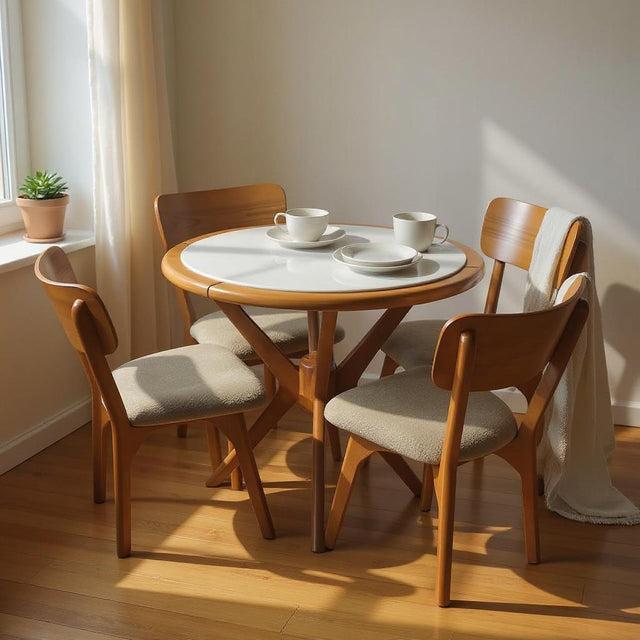
Round dining tables can be an excellent choice for smaller dining rooms, breakfast areas and open living spaces where efficient use of floor space is important. Because there are no corners, a round tabletop can make it easier to move around the dining area, particularly when the table is positioned near a walkway or other furniture.
A round table can also work well in a square dining area, where its shape naturally follows the proportions of the room. Instead of filling the space with the length and corners of a rectangular table, a round table creates a more balanced footprint while maintaining access from several directions.
For smaller spaces, a 42- or 48-inch round table can provide comfortable everyday seating for four without overwhelming the room. If additional seating is occasionally needed, an extendable round table can provide more flexibility without requiring a larger table to occupy the space every day.
Is a Round Table More Space-Efficient Than a Rectangular Table?
It depends on the shape of the room and the number of people you need to seat.
In a small square room, a round table can often make movement around the dining area feel easier because there are no corners extending into walkways. Round tables also allow chairs to be arranged around the perimeter rather than being tied to clearly defined sides.
In a long or narrow dining room, however, a rectangular table may use the available space more efficiently. Its shape follows the proportions of the room and can provide more seating without requiring as much width.
This is why the best table shape isn't determined by room size alone. Consider the shape of the available dining area, required seating capacity and surrounding traffic flow. A table that works beautifully in a 10-by-10-foot dining area may not be the best choice for a room with the same square footage arranged in a long, narrow layout.
Choosing Dining Chairs for a Round Table
The size and style of your dining chairs can have almost as much impact on seating capacity as the diameter of the table itself. When several chairs are positioned around a round table, even a few extra inches of chair width can make a noticeable difference.
Start by looking at the overall width of the chair, not just the width of the seat. Wider upholstered chairs, armchairs and chairs with substantial frames require more space around the table than narrower side chairs.
For example, six moderately sized dining chairs may fit comfortably around a 60-inch round table, while six oversized upholstered chairs around the same table could feel crowded. This is one reason seating-capacity recommendations should always be considered together with the chairs you plan to use.
Do Dining Chairs Need to Match a Round Table?
No. Dining chairs don't have to be part of a matching set, but their proportions should work well with the table.
Pay attention to seat height, chair width and arm height. Most importantly, make sure there is enough vertical space between the chair seat and the underside of the tabletop for comfortable seating. If you're considering armchairs, check that the arms can fit beneath the table when you want to push the chairs in.
The table base also matters. With a pedestal table, chairs can often be positioned more freely around the perimeter. With a four-leg table, make sure the chairs can be arranged without forcing diners to sit directly in front of a table leg.
How Many Chairs Can You Fit Around a Round Table?
Rather than choosing chairs based solely on the table's advertised seating capacity, consider how much space each chair occupies around the table.
If you're trying to decide between four and six chairs—or six and eight—measure the chair width and consider how closely the chairs will sit when everyone is at the table. Allowing a little additional space between chairs usually creates a much more comfortable dining experience than simply fitting the maximum number possible.
Round vs. Rectangular Dining Tables
Round and rectangular dining tables can both provide comfortable seating, but the shape of the room and the way you use the dining area can make one more practical than the other.
A round dining table works particularly well in square or compact dining areas. With no corners, it can create a more open feeling around the table and make it easier to move between chairs and nearby furniture. Round tables also encourage conversation because everyone is positioned toward the center rather than separated along opposite sides.
A rectangular dining table is often better suited to longer or narrower rooms. It can also be a practical choice when seating larger groups because additional chairs can be distributed along the length of the table.
Ultimately, the best table shape is the one that accommodates your everyday seating needs while leaving enough room for chairs and comfortable movement around the dining area. When comparing different dining room sets, consider the shape of the room along with the number of people you plan to seat.
Which Table Shape Is Better for Entertaining?
Neither shape is automatically better. The best choice depends on the number of guests, room dimensions and how you prefer to serve meals.
Round tables create an intimate seating arrangement where guests can easily see one another, making them especially appealing for smaller gatherings. Rectangular tables can make it easier to accommodate larger groups and provide additional surface area for serving dishes as the table length increases.
If you like the conversational feel of a round table but occasionally need additional seating, an extendable round table can offer a useful compromise. It can remain round for everyday dining and, depending on its design, extend into an oval or elongated shape when additional guests need to be seated.
Choosing a Round Dining Table for Holiday Entertaining
Holiday entertaining can change the way a dining table is used. A table that comfortably handles everyday meals for four may suddenly need to accommodate six or more people, additional place settings, serving dishes and centerpieces.
If you entertain regularly, consider both your everyday seating needs and your occasional maximum seating needs. Buying a table solely for the largest gathering of the year can leave you with an unnecessarily large table for the rest of the time.
An extendable round dining table can provide a practical solution. It allows you to maintain a smaller, more comfortable footprint for everyday dining while creating additional table space when family and guests arrive.
Also think about how much usable tabletop space you'll need. Holiday meals often involve more serving pieces than everyday dining, so a table that technically fits six chairs may still feel crowded once place settings, platters and decorations are added.
Most importantly, don't sacrifice room clearance simply to add another chair. Guests should still be able to pull their chairs out comfortably and move around the dining area without squeezing between the table and nearby walls or furniture.
If you're preparing your dining room for Thanksgiving, Christmas or other larger gatherings, our How to Choose a Dining Table for Holiday Entertaining: Size, Seating & Space guide takes a closer look at planning for guests, room dimensions and additional seating.
Frequently Asked Questions
What size round dining table is best for 4 people?
A 42- to 48-inch round dining table is a good choice for four people. A 42-inch table provides comfortable everyday seating in a relatively compact space, while a 48-inch table offers additional elbow room and tabletop space.
What size round dining table is best for 6 people?
A 54- to 60-inch round dining table can generally accommodate six people. If six people will use the table regularly, a 60-inch table usually provides more comfortable seating and additional space for place settings and serving dishes.
Can 6 people sit comfortably at a 60-inch round table?
Yes. A 60-inch round table can comfortably seat six people in most configurations. Chair width and table-base design can affect the amount of available space, so these should also be considered when choosing a table.
Can 8 people sit at a 72-inch round table?
Yes. A 72-inch round dining table can comfortably accommodate eight people with appropriately sized chairs. Because a table this size has a 6-foot diameter, make sure the dining room also provides sufficient clearance around the table.
How much space should you leave around a round dining table?
Allow approximately 36 inches between the edge of the table and nearby walls or furniture as a general guideline. If people regularly need to walk behind occupied chairs, providing 42 to 48 inches can make the dining area more comfortable.
Is a pedestal table better for seating more people?
A pedestal base can provide greater flexibility when arranging chairs because there are no individual table legs near the perimeter. However, pedestal bases vary in size, so it's still important to consider available legroom underneath the table.
Are round dining tables good for small dining rooms?
Yes, particularly in small or square dining areas. Without corners, a round table can make movement around the dining area easier. A 42- or 48-inch round table is often a practical choice when seating four people in a smaller space.
What size round table should I buy if I occasionally need extra seating?
Consider an extendable round dining table. It can remain smaller for everyday use and provide additional table space when guests arrive. Check the table's fully extended dimensions and recommended seating capacity before purchasing.